
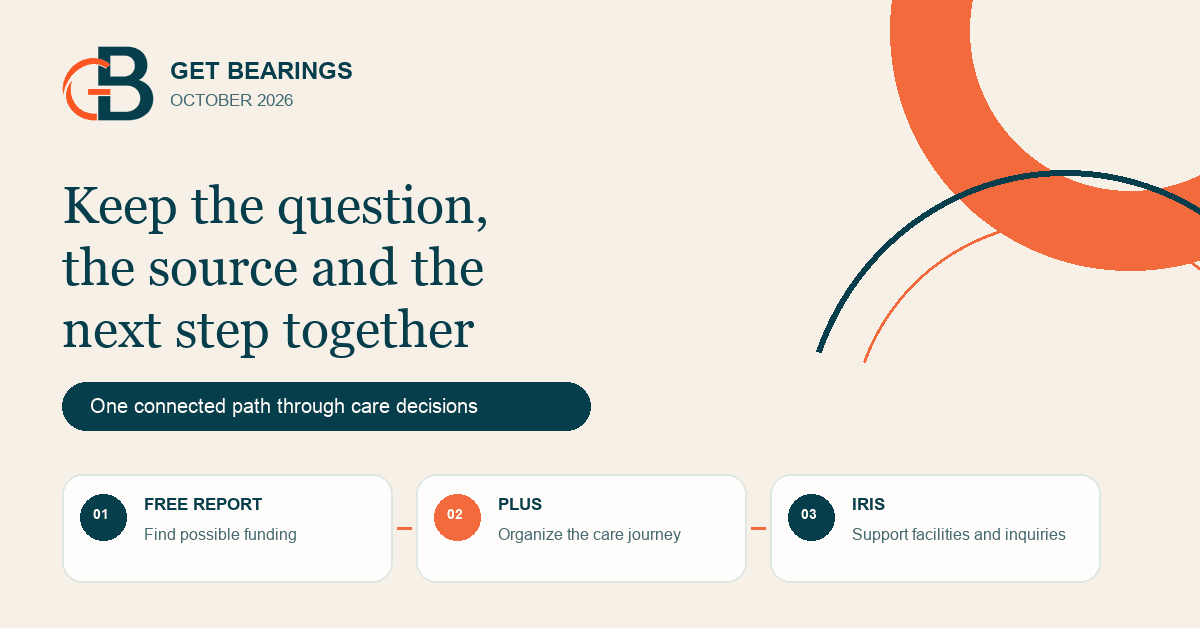
Keep the question, the source and the next step together
The October 2026 Get Bearings newsletter: one small habit that makes care conversations easier to follow.
By Brent, Co-Founder & CEO · · 5 min read
Research checked October 9, 2026.
Key takeaways
This October, we’re focusing on one small habit that can make those conversations easier to follow: keep the question, the source and the next step together. For your next care conversation, start small: one question, its source and a clear next step.
When someone you love needs care, a search can quickly turn into a second job. There are calls to make, unfamiliar terms to understand and decisions that affect the whole family. Underneath that work is a simple hope: to feel confident that the person you love is safe, supported and cared for.
This October, we’re focusing on one small habit that can make those conversations easier to follow: keep the question, the source and the next step together.
Begin with the person, then the question
Before the next call, ask the person you’re supporting what they most want to understand. Perhaps they want to know what daily life would look like in a care community, how they can stay connected with family or what support is available at home. Or if they are physically able, always take them to see the space in person. Write the questions in their words.
You don’t have to answer everything in one sitting. Choose one question to begin with, and leave space beside it to write down what you learn. This helps keep their priorities visible as paperwork and practical decisions accumulate.
Keep the source beside the answer
With AI today, if you are comfortable, record the conversation so it can be summarised (ask everyone first; some states require it). If you are like me, you may forget an important piece that they stress.
When you find useful information, save where it came from. Include the organisation’s name, its official page and the date or year the information applies to. If something is unclear, note who you can ask to explain it. For example, a note that says “call about this program” is easy to lose track of. A note with the program name, source link, your question and the right contact gives you a starting point when you return to it. You can also show someone helping or working with you exactly what you found.
Make the next step easy to pick up!
Before ending a conversation, ask: “What happens next, and who should I contact if I need help?” Record the answer while it is fresh. If several people are helping, agree who will take the next action and where you’ll keep the notes. A sibling, doctor or care provider may join the conversation later. Having the question, source and next action together can help them understand what has already been discussed. It can also make it easier to see which questions still need an answer.
A free place to start, with Plus to help you share care documents!
The Get Bearings Report is now completely FREE. We want more families to have a clearer place to begin as they explore care, benefits and possible next steps. Plus is $9 a month or $89 a year, with 30 days free.
Get Bearings Plus connects directly with your free Report and lets you share care information with the family members you choose.
Get your free Report at getbearings.us and explore Plus at getbearings.us/plus.
Building Iris with the facilities that use it
The provider side of these conversations matters too. A family’s question may pass between colleagues, while a care team is also managing availability, daily tasks and changes throughout the community. Not to mention managing care, medications, operations, meals, kind conversations, keeping people active. They have a lot on their plates. We’re building Iris with facilities and thinking beyond inquiries and availability. Our longer-term vision is one place to support the work of running a care business, shaped by the people doing that work.
What would make the biggest difference: shared checklists, move-out records, accounting or other types of integrations, or something else?
We’re also interested in exploring where AI might help, such as organising inspection photos or supporting checkout tasks. These are possibilities to develop together. We want facility teams to tell us what is useful, what is missing and what should come first. We’d design anything like this to keep residents’ personal and health information out of it.
Help us make the next family’s experience clearer!
If you use our free Get Bearings Report, we’d welcome your feedback. What helped? What needed a clearer explanation? What did you want to do next? You can let us know through Contact Us at getbearings.us/contact. Participation is optional.
Facilities can list for free today, and we’re inviting a small number of communities into a free pilot of our paid features. Message us at the same link.
WE WANT TO BUILD THIS WITH YOU - Facility teams can use the Feature Request page inside Iris to help shape the solution from the start. Bring us a real task or a general example of where work gets stuck, without including anyone’s private information. We want to help you care for the family members in your care more efficiently and in a caring and cost-effective way.
For your next care conversation, start small: one question, its source and a clear next step. That is something the next person helping you can pick up.
Brent, Meelis, and the Get Bearings Team